
Comparing Mortgage Options for Self-Employed Borrowers After Denial
Receiving a mortgage denial is a stressful milestone for any homebuyer, but it hits self-employed professionals with unique intensity. According to recent industry data, nearly 30% of loan applications from self-employed individuals face initial hurdles due to how traditional underwriting interprets tax returns. This statistic highlights a critical gap in the conventional lending model. If you have been declined, it does not mean your financing journey is over. It means you need a different strategy. The key lies in understanding which alternative programs value your cash flow over your reported taxable income.
Understanding Why Self-Employed Loans Get Denied
Traditional mortgage underwriting relies heavily on a two-year history of W-2 income. For self-employed borrowers, this metric is often misleading. Your tax returns may show low income due to legitimate business deductions, depreciation, or strategic write-offs that reduce your taxable profit. However, your actual cash flow remains robust. When a conventional lender sees a low net income on Schedule C, they calculate a high debt-to-income ratio (DTI) and deny the application. This is not a reflection of your ability to repay; it is a limitation of the algorithm.
Another common reason for denial is insufficient reserve requirements. Conventional loans often require six to twelve months of mortgage payments in liquid assets. Self-employed businesses often reinvest capital, leaving less personal liquidity. Additionally, inconsistent income patterns can trigger red flags. If your income fluctuates significantly year over year, lenders may use the lower of the two years to qualify you, further hurting your approval odds. Understanding these mechanical failures is the first step to finding a lender who looks at the whole picture.
Bank Statement Loans: The Cash Flow Alternative
Bank statement loans are specifically engineered for borrowers who cannot use standard tax return documentation. Bank statement qualifying allows lenders to underwrite your loan based on 12 to 24 months of personal or business bank statements. This program ignores your tax returns entirely. Instead, it calculates your average monthly deposits and applies a standard expense ratio to determine your qualifying income.
This option is ideal for contractors, freelancers, and small business owners who have maximized their deductions. By focusing on gross revenue rather than net profit, you often qualify for a higher loan amount than you would with traditional tax return lending. The trade-off is typically a slightly higher interest rate and a larger down payment, often ranging from 10% to 20%. However, the ability to bypass the tax return limitation makes this a powerful tool for post-denial recovery.
For investors, this approach is even more potent. It allows you to scale your portfolio without being capped by your personal W-2 income. If you are looking to explore specialized investment property financing, bank statement programs provide the flexibility that conventional banks simply cannot offer.
Add-Back Strategies and Tax Return Lending
Not all denials require abandoning tax return lending. Some lenders offer add-back strategies that allow you to include non-cash expenses back into your income calculation. Common add-backs include depreciation, amortization, and business-related travel or vehicle expenses. These are expenses that reduced your taxable income but did not actually cost you cash.
When a lender applies these add-backs, your qualifying income increases significantly. This can be the difference between a denial and an approval. However, this strategy requires a lender who is willing to manually underwrite your file. Automated underwriting systems often reject these adjustments. You need a Senior Loan Officer who understands how to present your financial story effectively.
If your business has grown significantly in the last two years, you may also qualify based on your most recent year's income alone. This is known as a year-over-year growth analysis. It rewards entrepreneurs who are scaling their operations, ensuring that your past lower income does not penalize your future earning potential.
DSCR Loans for Investment Properties
If your denial was related to personal income limitations, consider shifting your focus to investment properties. Debt Service Coverage Ratio (DSCR) lending flips the underwriting model entirely. DSCR lending qualifies the loan based on the property's rental income, not your personal income. If the property generates enough rent to cover the mortgage, taxes, and insurance, you can qualify regardless of your employment status.
This is particularly effective for the BRRRR strategy: Buy, Rehab, Rent, Refinance, Repeat. You can acquire distressed assets, force appreciation, and then pull your capital back out. For self-employed borrowers, this removes the personal income ceiling that often blocks portfolio growth. With DSCR loans available in over 40 states, you are not limited by your physical location or state-specific licensing.
Investors can also utilize delayed financing options to recoup cash after an all-cash purchase. This allows you to buy a property with cash and then refinance it shortly after, unlocking your equity without the traditional six-month seasoning period required by many conventional lenders.
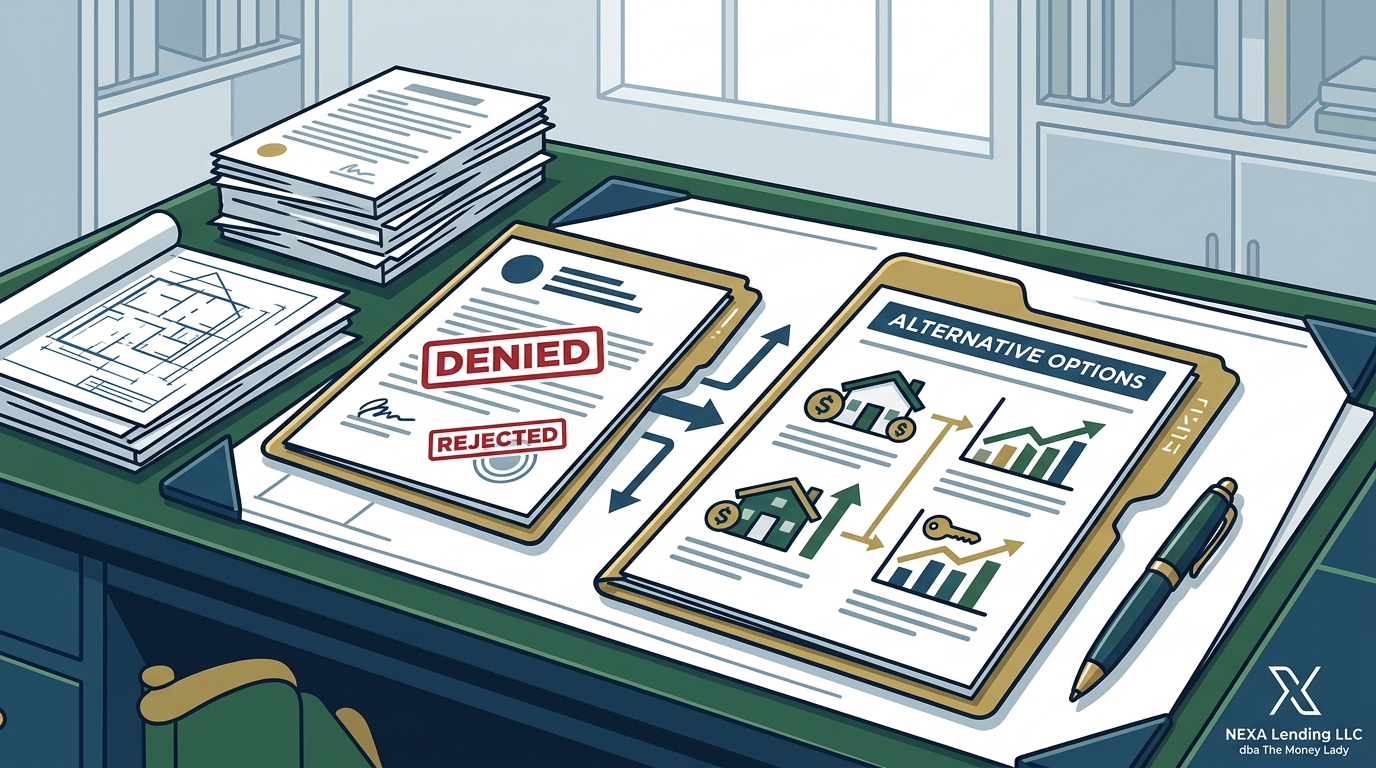
Comparing Your Post-Denial Options
Choosing the right path requires comparing the specific mechanics of each loan type. The table below outlines the key differences between the primary options available to self-employed borrowers who have faced denial.
| Loan Program | Documentation Required | Income Qualification Method | Best For | Down Payment |
|---|---|---|---|---|
| Bank Statement Loan | 12-24 Months Bank Statements | Gross Deposits minus Expenses | High Deduction Business Owners | 10% - 20% |
| Tax Return Add-Back | 2 Years Tax Returns | Net Income + Non-Cash Add-Backs | Growing Businesses with Depreciation | 3% - 20% |
| DSCR Investment Loan | Property Rent Roll | Property Cash Flow Only | Real Estate Investors | 15% - 25% |
| Jumbo Loan | Full Financial Package | High-Net-Worth Underwriting | Luxury Home Buyers | 20% - 30% |
Key Takeaways for Borrowers
- Denial is often mechanical: Most self-employed denials result from algorithmic misinterpretation of tax deductions, not creditworthiness.
- Bank statements replace tax returns: Bank statement loans use gross deposits to calculate income, bypassing Schedule C limitations entirely.
- Add-backs increase income: Including depreciation and amortization back into your income can significantly boost your qualifying amount.
- DSCR ignores personal income: Investment property loans qualify based on rental income, offering a path to portfolio growth without personal income caps.
- Reserves matter: Self-employed borrowers often need larger cash reserves to offset the perceived risk of variable income.
- Manual underwriting is key: Automated systems often reject self-employed profiles; human underwriters can find the right fit.
- Specialized lenders are essential: Not all lenders offer bank statement or DSCR products. You need a partner who understands these niche programs.
Frequently Asked Questions
Can I get a mortgage after being denied for self-employment?
Yes. Many lenders offer specialized programs like bank statement loans or DSCR loans that do not rely on traditional tax return income. These programs focus on cash flow and asset reserves instead.
What is a bank statement loan?
A bank statement loan is a mortgage product that uses 12 to 24 months of personal or business bank statements to verify income. It is designed for self-employed borrowers who have high deductions on their tax returns.
How do add-backs work in mortgage underwriting?
Add-backs allow lenders to include non-cash expenses, such as depreciation and amortization, back into your net income. This increases your qualifying income without requiring additional cash flow.
Do I need a high credit score for self-employed loans?
While credit scores are still important, some self-employed programs are more flexible. Bank statement loans may accept lower credit scores than conventional loans, but a score above 700 typically yields better rates.
What is the minimum down payment for a bank statement loan?
Down payment requirements vary by lender and loan type. Typically, bank statement loans require a minimum of 10% to 20% down payment, depending on the number of units and occupancy type.
Can I buy an investment property with no personal income verification?
Yes. DSCR loans qualify based on the property's rental income. If the rent covers the mortgage, your personal income is irrelevant. This is ideal for investors looking to scale their portfolio.
How long does it take to get approved with a bank statement loan?
Approval times can be faster than conventional loans because the documentation is simpler. However, manual underwriting may take slightly longer than automated systems. Expect a timeline of 30 to 45 days from application to closing.
Next Steps: Rebuilding Your Financing Path
A mortgage denial is not a dead end. It is a signal to pivot your strategy. Whether you need the cash flow visibility of a bank statement loan, the income boost of add-backs, or the investment focus of DSCR lending, there is a path forward. The most critical step is working with a lender who understands the self-employed borrower's unique financial landscape.
Christine Cox, a Senior Loan Officer with over 15 years of experience, specializes in these complex scenarios. She helps investors, homeowners, and veterans build wealth through smarter financing. Do not let a denial stop your progress. Start your financial triage assessment today to diagnose your specific scenario and find the optimal capital stack for your goals.