

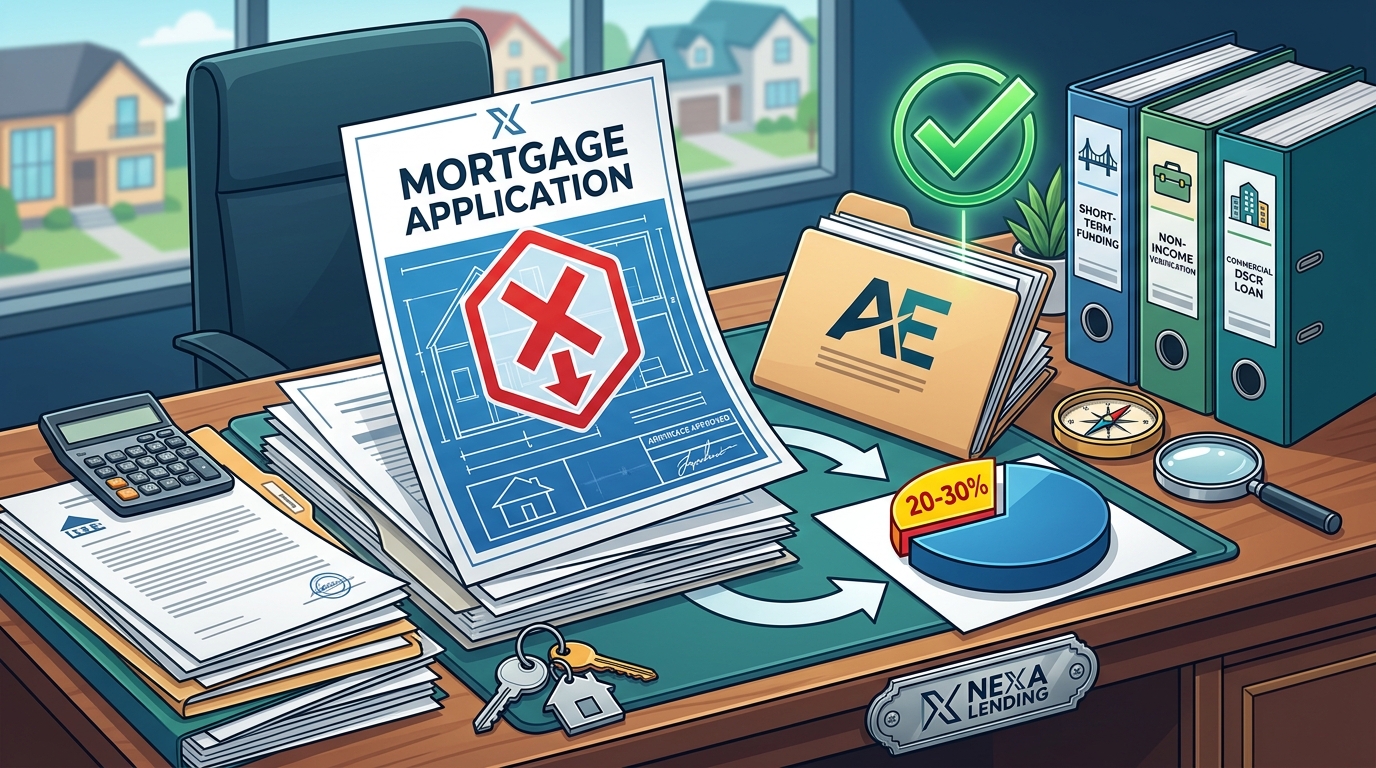
When a primary mortgage application is denied or delayed at the last minute, buyers face immediate financial exposure. According to recent industry data, approximately 20 to 30 percent of mortgage applications encounter significant hurdles before closing. This statistic highlights the critical need for backup financing strategies. Without a clear plan, buyers risk losing earnest money deposits or missing out on desirable properties. Understanding the difference between emergency lenders and alternative financing is essential for protecting your investment.
Understanding Why Mortgages Fall Through
A primary mortgage can fail for several reasons. Lenders may discover issues during the underwriting process that were not apparent during pre-approval. Common causes include a drop in credit score, a change in employment status, or a low appraisal. In some cases, the lender simply cannot close the loan on time due to backlog or documentation errors. Christine Cox, a Senior Loan Officer at NEXA Lending, emphasizes that having a backup plan is crucial for any serious home buyer.
When the primary loan fails, you must act quickly. Time is of the essence in real estate transactions. Every day that passes can increase the cost of holding the property or cause the seller to walk away. This is where emergency lenders and alternative financing options come into play. Both paths offer solutions, but they operate differently and carry distinct risks.
Emergency Lenders: Speed and Flexibility
Emergency lenders are typically private individuals or small investment groups that provide short-term capital. These lenders focus on speed and flexibility rather than the strict regulatory compliance of traditional banks. They often use asset-based lending criteria, meaning they look at the value of the collateral rather than just your income.
Hard money loans are a common form of emergency financing. These loans are secured by the property itself. If you cannot secure a conventional mortgage, a hard money lender can provide funds to close the deal. The interest rates are higher, often ranging from 8 to 15 percent. However, the approval process is much faster, sometimes taking only a few days.
Another option is a bridge loan. Bridge loans are designed to cover the gap between buying a new home and selling an existing one. They are also useful when a primary mortgage falls through. Bridge loans are short-term, usually lasting six months to three years. They allow you to close on the new property immediately while you resolve the issues with your primary lender.
Christine Cox at NEXA Lending offers DSCR (Debt Service Coverage Ratio) loans for investors. These loans qualify based on the rental income of the property rather than the borrower's personal income. This can be a viable emergency option for investment properties when traditional income verification fails.
Alternative Financing Options
Alternative financing encompasses a broader range of tools beyond traditional emergency lending. These options include personal loans, home equity lines of credit (HELOCs), and seller financing. Each has its own set of requirements and benefits.
Personal loans can provide quick cash for a down payment or closing costs. However, they are unsecured, meaning they do not use the property as collateral. Interest rates for personal loans are generally higher than mortgage rates. They also have shorter repayment terms, which can strain your monthly budget.
HELOCs are useful if you already own a property with significant equity. You can borrow against that equity to fund the new purchase. This option is cost-effective if you have a good credit score and sufficient equity. However, it puts your existing home at risk if you cannot repay the loan.
Seller financing is another alternative. In this scenario, the seller acts as the lender. You make payments directly to them instead of a bank. This option is rare but can be very flexible. Terms are negotiable, and approval is often easier than with traditional lenders. It is particularly useful in competitive markets where sellers want to ensure the sale goes through.
For those with unique financial situations, bank statement loans are available. These loans use bank statements instead of tax returns to verify income. This is helpful for self-employed individuals or those with complex financial profiles. Christine Cox at NEXA Lending can help determine if this option is suitable for your specific case.
Comparison of Financing Options
Choosing the right backup financing requires comparing key factors. The table below outlines the main differences between emergency lenders and alternative financing options.
| Financing Type | Speed of Funding | Interest Rates | Best For | Risk Level |
|---|---|---|---|---|
| Hard Money Loans | Very Fast (Days) | High (8-15%) | Investors, Fixer-Uppers | High (Asset Collateral) |
| Bridge Loans | Fast (Weeks) | Moderate to High | Buying Before Selling | Moderate |
| DSCR Loans | Moderate | Moderate | Rental Properties | Moderate |
| Personal Loans | Fast (Days) | High | Down Payment Only | High (Unsecured) |
| Seller Financing | Variable | Negotiable | Flexible Terms | Low to Moderate |
Key Takeaways
- Speed vs. Cost: Emergency lenders offer speed but at a higher cost. Alternative financing may be cheaper but slower to approve.
- Asset-Based Lending: Hard money and bridge loans rely on property value, not just credit scores. This makes them accessible to those with credit issues.
- DSCR Loans: These loans qualify based on rental income, making them ideal for investors who cannot use personal income for verification.
- Seller Financing: This option provides flexibility but is rare. It requires a willing seller and strong negotiation skills.
- Pre-Approval is Key: Getting pre-approved with multiple lenders reduces the risk of a primary mortgage falling through.
- Christine Cox's Expertise: As a Senior Loan Officer, Christine Cox provides guidance on FHA, VA, USDA, and conventional loans, ensuring you have the best primary option.
- NMLS Verification: Always verify your loan officer's credentials. Christine Cox's NMLS number is 2040696.
Frequently Asked Questions
What is the fastest way to get a backup mortgage?
Hard money loans are typically the fastest option, with funding possible in as little as a few days. However, they come with higher interest rates and fees.
Can I use a personal loan for a mortgage backup?
Yes, you can use a personal loan for a down payment or closing costs. However, it is not suitable for the entire mortgage amount due to higher interest rates and shorter terms.
What is a DSCR loan?
A DSCR loan is a mortgage that qualifies based on the rental income of the property rather than the borrower's personal income. It is ideal for investment properties.
How do I find a reliable emergency lender?
Work with a licensed mortgage loan officer who has access to a network of private lenders. Christine Cox at NEXA Lending can connect you with reputable emergency lenders.
What happens if I cannot secure backup financing?
If you cannot secure backup financing, you may lose your earnest money deposit. It is crucial to have a contingency clause in your purchase agreement that allows you to back out if financing fails.
Are bridge loans only for investors?
No, bridge loans are available to homeowners who need to buy a new home before selling their current one. They provide temporary financing until the existing home is sold.
How does Christine Cox help with backup financing?
Christine Cox helps clients explore all available options, including conventional, FHA, VA, and USDA loans, as well as alternative financing like DSCR and bridge loans. She ensures you have a clear path to closing.
Next Steps
Do not wait until your primary mortgage falls through to plan for the worst. Contact Christine Cox at NEXA Lending today to discuss your options. Whether you need a conventional loan, a DSCR loan, or guidance on emergency financing, she is here to help. Call (850) 296-9004 or visit yourmoneylady.com to get started. Secure your future with expert mortgage advice.