
Navigating the mortgage landscape as a self-employed professional requires a fundamentally different approach than traditional W-2 employment. Lenders view self-employment as a higher-risk category due to the variability of income streams and the complexity of tax filings. According to recent industry data, approximately 36% of the U.S. workforce is now self-employed, yet these borrowers often face stricter scrutiny during the underwriting process. This guide details the precise documentation and verification standards you must meet to secure financing through Paradise Lending LLC. (CCOX VENTURES LLC Contact)
Understanding Income Verification Standards
The core challenge for self-employed borrowers is proving stable income. Traditional employees provide pay stubs and W-2 forms, which offer a clear, linear view of earnings. Self-employed individuals must demonstrate that their net income is consistent and likely to continue. Net income is the total profit remaining after all business expenses are deducted from gross revenue. Lenders focus heavily on this bottom line rather than gross revenue. (CCOX VENTURES LLC Terms)
Paradise Lending LLC specializes in bridging the gap between complex business finances and lender requirements. We understand that your business structure dictates your documentation needs. Whether you operate as a sole proprietor, a single-member LLC, or an S-Corporation, the verification process remains rigorous. The goal is to present a financial narrative that aligns with lender guidelines while accurately reflecting your business reality. (CCOX VENTURES LLC Terms)
Required Tax Documentation
Tax returns are the primary source of truth for self-employed income verification. Lenders typically require two full years of personal and business tax returns. This historical data allows underwriters to calculate an average income, smoothing out any anomalies from a single fiscal year.
Personal Tax Returns
Your personal Form 1040 is the foundation of your application. It provides the lender with a holistic view of your financial life, including other income sources, debts, and assets. Ensure that all schedules are included and that any discrepancies between your filed returns and your current financial situation are explained.
Business Tax Returns
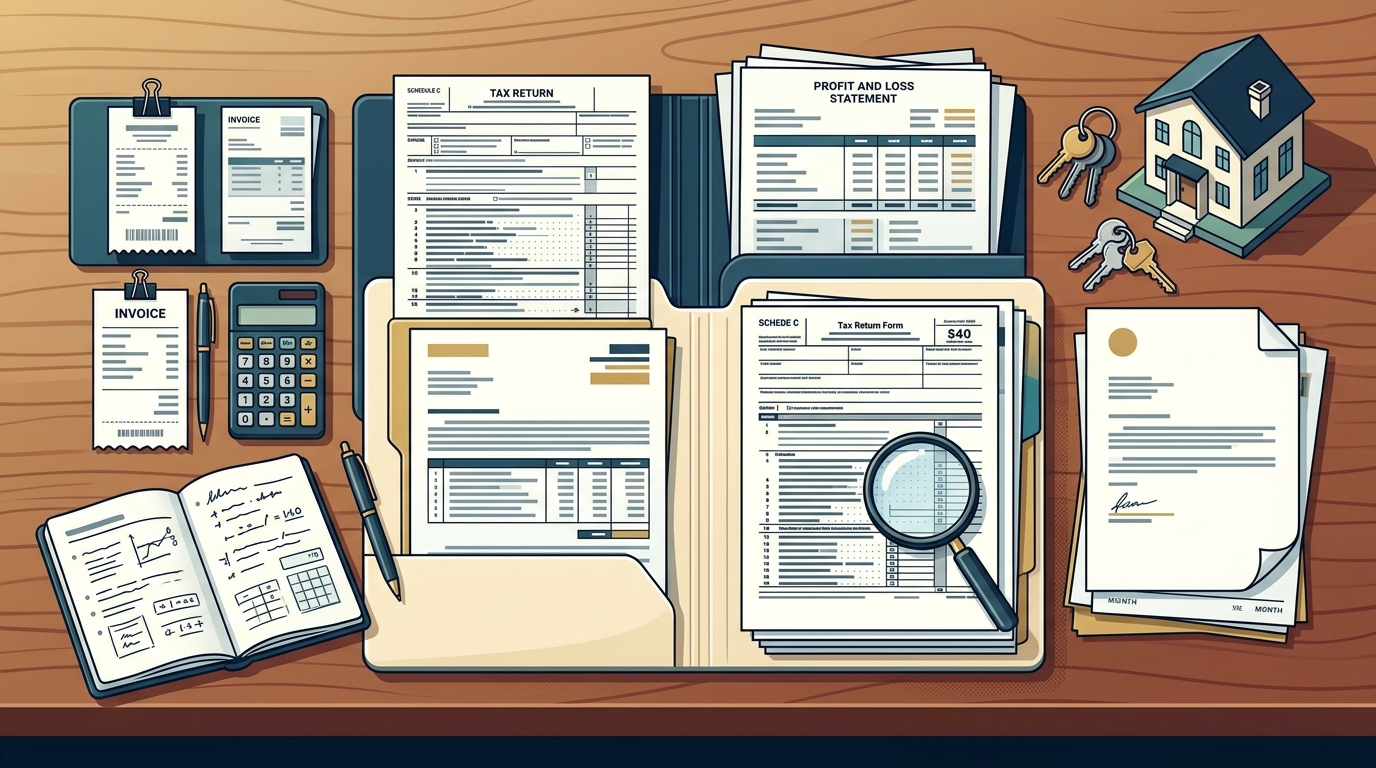
Depending on your entity type, you will submit different schedules. For sole proprietors and single-member LLCs, Schedule C is critical. This form details your gross receipts and allowable business expenses. Gross receipts are the total amount of money received from business activities before any expenses are subtracted. Lenders will scrutinize Schedule C to ensure that expenses are legitimate and necessary for the business.
For S-Corporations, you must provide Schedule K-1, which outlines your share of the company's income. C-Corporations require Form 1120. Each form serves a specific purpose in calculating your qualifying income. At Paradise Lending LLC, we help you interpret these forms to maximize your qualifying income potential.
Alternative Verification: Bank Statement Loans
Not all self-employed borrowers fit the traditional tax return mold. Some professionals have written off significant expenses to reduce tax liability, resulting in low or negative net income on their tax returns. For these individuals, bank statement loans offer a viable alternative.
Bank statement loans verify income based on cash flow rather than taxable income. Lenders analyze 12 to 24 months of business bank statements to determine average monthly deposits. This method is particularly beneficial for real estate investors, freelancers, and contractors who have high revenue but low taxable income due to depreciation or other deductions.
According to financial industry reports, bank statement loan programs have grown in popularity by over 20% in the last five years as more lenders recognize the value of cash flow analysis. Paradise Lending LLC connects you with lenders who specialize in these alternative products, ensuring you are not penalized for smart tax planning.
Profit and Loss Statements
A Profit and Loss (P&L) statement, also known as an income statement, provides a snapshot of your business performance over a specific period. For self-employed borrowers, a year-to-date (YTD) P&L is often required alongside tax returns.
This document must be prepared by a CPA or a qualified accountant. It should reflect your current financial status accurately, including any recent changes in revenue or expenses. A Profit and Loss statement is a financial report that summarizes the revenues, costs, and expenses incurred during a specific period. Lenders use this to verify that your income has not declined significantly since your last tax filing.
At Paradise Lending LLC, we advise clients to maintain up-to-date P&L statements throughout the year. This proactive approach simplifies the mortgage application process and reduces the risk of delays caused by missing documentation.
Common Documentation Pitfalls
Even well-prepared borrowers can face rejection due to common documentation errors. Understanding these pitfalls allows you to address them proactively.
- Inconsistent Bank Statements: Large, unexplained deposits can raise red flags. Ensure all significant transactions are documented and explained.
- Unreported Income: All income must match your tax returns. Discrepancies between bank deposits and reported income can lead to immediate denial.
- High Debt-to-Income Ratio: Lenders calculate your DTI based on your qualifying income. If your income is low due to deductions, your DTI may appear high. We help structure your application to mitigate this.
- Missing Documents: Incomplete tax returns or missing schedules are the most common cause of delays. Submit everything requested by Paradise Lending LLC.
By avoiding these common mistakes, you position yourself for a smoother approval process. Our team at Paradise Lending LLC reviews every document before submission to ensure compliance with lender guidelines.
Key Takeaways
- Self-employed borrowers must provide two years of personal and business tax returns.
- Net income, not gross revenue, is the primary metric for income qualification.
- Bank statement loans offer an alternative for those with low taxable income.
- Year-to-date Profit and Loss statements are essential for current income verification.
- Paradise Lending LLC specializes in guiding self-employed clients through complex verification.
- Consistency between bank statements and tax returns is critical for approval.
- Early preparation of documentation reduces processing time and rejection risks.
Frequently Asked Questions
What is the minimum credit score for self-employed mortgages?
While requirements vary by lender, most conventional loans require a minimum credit score of 620. However, Paradise Lending LLC works with lenders who may accept lower scores for self-employed borrowers with strong cash flow.
Can I use bank statements instead of tax returns?
Yes, bank statement loans allow you to verify income using 12 to 24 months of business bank statements. This option is ideal for borrowers who have written off significant expenses on their tax returns.
How do lenders calculate income for self-employed borrowers?
Lenders typically average the net income from your last two years of tax returns. They add back certain non-cash expenses like depreciation and amortization to determine your qualifying income.
What if my income has decreased this year?
If your current income is lower than your historical average, you may need to provide a strong explanation or use a bank statement loan program. Paradise Lending LLC can help you navigate these scenarios.
Do I need a CPA to prepare my documents?
While not always mandatory, having a CPA prepare your Profit and Loss statement and review your tax returns is highly recommended. It ensures accuracy and reduces the likelihood of lender inquiries.
How long does the approval process take?
The timeline varies based on documentation completeness. With organized records, approval can take 30 to 45 days. Paradise Lending LLC streamlines this process by pre-screening your documents.
What is the difference between Schedule C and Schedule K-1?
Schedule C is used by sole proprietors and single-member LLCs to report business income and expenses. Schedule K-1 is used by S-Corporation shareholders to report their share of the company's income.
Contact Paradise Lending LLC
Securing a mortgage as a self-employed professional requires expertise and precision. Paradise Lending LLC is dedicated to empowering your success with tailored mortgage guidance. We understand the unique challenges you face and provide the support needed to navigate them.
Visit our About Us page to learn more about our mission. Contact us today to discuss your specific needs and start your journey toward homeownership. Our team is ready to assist you with expert advice and reliable solutions.