

Common Rental Income Qualuation Mistakes in Investment Property Financing
Investors frequently underestimate how lenders calculate rental income, leading to denied applications or inflated debt-to-income ratios. According to the National Association of Realtors, investment property financing requires stricter underwriting standards than primary residence loans because the income is considered less stable. This article outlines the critical errors borrowers make when presenting rental data to loan officers like Christine Cox at NEXA Lending.
Mistake 1: Using Gross Rent Instead of Net Income
One of the most prevalent errors in investment property financing is presenting gross rental income without accounting for operational expenses. Lenders do not view the full rent check as available cash flow. Instead, they apply a discount factor to ensure the property can sustain itself during economic downturns. This practice protects the borrower from overleveraging based on optimistic revenue projections.
Net Operating Income (NOI) is the total revenue from the property minus all operating expenses, excluding mortgage payments. When you submit an application, the underwriter will typically use 75% of the gross rent to calculate qualification. This means if your property generates $2,000 per month, the lender may only count $1,500 toward your income. Using the full amount can artificially lower your debt-to-income ratio, leading to approval that later fails during the audit phase.
To avoid this, always prepare a detailed profit and loss statement. This document should clearly separate income from expenses like taxes, insurance, and repairs. For a deeper understanding of how these calculations affect your approval, review the Advanced Mortgage Calculator provided by NEXA Lending. It allows you to model different scenarios based on realistic net income figures.
Mistake 2: Ignoring Vacancy and Maintenance Reserves
Another critical mistake is assuming 100% occupancy throughout the loan term. No rental property is ever fully occupied every single month. Lenders require borrowers to account for this reality by deducting a vacancy rate from the gross income. Standard practice often involves subtracting 25% of the gross rent to cover vacancies and capital expenditures.
This deduction is not arbitrary. It reflects historical data showing that even high-demand markets experience turnover. If you ignore this factor, your calculated income will be significantly higher than what the lender will approve. This discrepancy can cause a last-minute denial just before closing. You must demonstrate that the property can cover its own mortgage even during periods of zero occupancy.
Furthermore, maintaining cash reserves is often a requirement for investment loans. Lenders typically ask for six months of mortgage payments in reserve for each property. This ensures you can continue paying the loan if the property becomes vacant. Understanding these requirements is essential for mortgage insights and market commentary that align with your investment strategy.
Mistake 3: Overlooking Property Management Fees
Many investors forget to include property management fees in their income calculations. If you hire a professional company to manage the rental, this fee is a direct reduction in your net income. Lenders will deduct this cost from the gross rent before applying the vacancy factor.
For example, if you pay 10% of the rent to a management company, that amount is gone before the lender even looks at the vacancy deduction. This double-dip effect can drastically reduce the income you qualify for. Investors often overlook this because they manage their own properties initially. However, if you plan to hire help later, the lender will still expect that cost to be accounted for in the qualification process.
Being transparent about management costs from the start prevents surprises. It also helps you determine if the property is truly cash-flow positive. For more guidance on managing your finances, check out the tips for improving your credit score which can also help in securing better loan terms.
Mistake 4: Failing to Document Historical Performance
4>For existing rental properties, lenders require proof of historical income. A common mistake is submitting a lease agreement for a future tenant without providing past performance data. If the property has been rented for less than 12 months, the lender may not count any of the income. This is because a short-term lease does not demonstrate stability.
You must provide tax returns, profit and loss statements, and bank statements showing consistent rent deposits. If you cannot provide this documentation, the lender will treat the property as vacant. This means you must qualify for the entire mortgage payment using your personal income. This can push your debt-to-income ratio over the limit, causing denial.
Proper documentation is key to a smooth application. Use the Document Checklist from NEXA Lending to ensure you have all necessary paperwork ready. This includes W-2s, tax returns, and bank statements. Having these documents organized can speed up the underwriting process significantly.
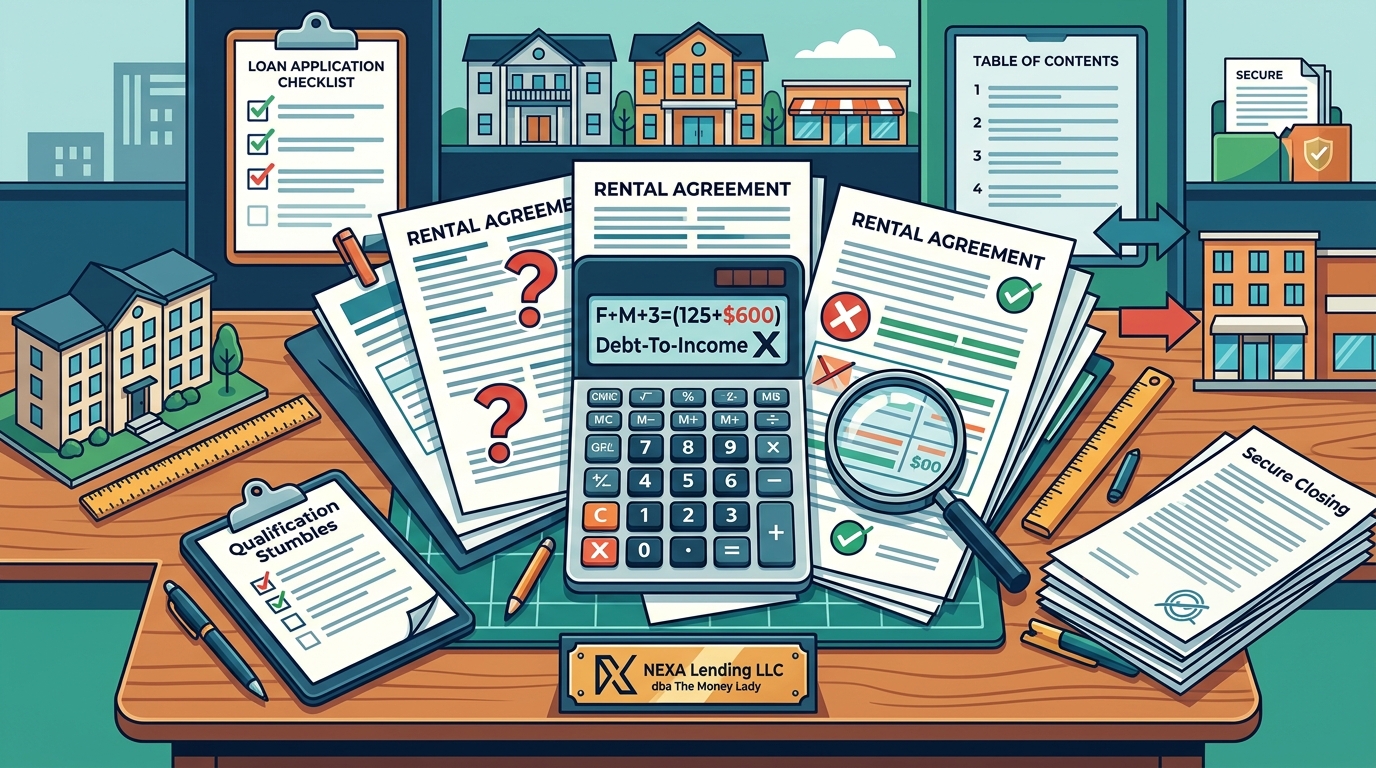
Mistake 5: Misunderstanding Debt-to-Income Impact
The final major mistake is misunderstanding how rental income affects your debt-to-income (DTI) ratio. Rental income is added to your total income, but the mortgage payment for the investment property is added to your total debts. The net effect is what matters.
If the net income is positive, it helps your DTI. If it is negative, it hurts your DTI. Many investors assume that because the rent covers the mortgage, the DTI impact is neutral. This is incorrect. Lenders use the discounted income method, which often results in a negative net income for the first few years of ownership. This negative number increases your DTI, potentially disqualifying you from the loan.
To navigate this, you need a clear view of your financial standing. Christine Cox at NEXA Lending specializes in helping investors understand these nuances. She can help you apply for a mortgage with a clear understanding of how the numbers will be calculated. This proactive approach ensures you are not caught off guard by DTI issues.
Key Takeaways
- Use Net Income: Lenders typically count only 75% of gross rent to account for vacancies and expenses.
- Account for Management: Property management fees must be deducted from gross rent before applying vacancy factors.
- Document History: Existing properties need at least 12 months of rental history to count toward income.
- Check Reserves: Six months of mortgage payments in reserve is a standard requirement for investment loans.
- Monitor DTI: Negative net income from a rental property increases your debt-to-income ratio.
- Prepare Documents: Use a comprehensive checklist to gather tax returns, bank statements, and leases.
- Consult an Expert: Work with a licensed loan officer like Christine Cox to avoid qualification pitfalls.
Frequently Asked Questions
How is rental income calculated for mortgage qualification?
Lenders typically calculate rental income by taking the gross rent and applying a vacancy factor, often 25%. They may also deduct property management fees and other operating expenses. The resulting net income is then used to offset the mortgage payment in your debt-to-income ratio.
Do I need a 12-month rental history to qualify?
For existing rental properties, lenders generally require 12 months of documented rental history. If the property has been rented for less than a year, the income may not be counted, and you will need to qualify for the full mortgage payment using your personal income.
What is the standard vacancy rate used by lenders?
The standard vacancy rate used by most lenders is 25% of the gross rent. This is a conservative estimate to ensure the property can sustain itself during periods of low occupancy. Some lenders may use a lower rate if the property is in a high-demand area with strong historical performance.
Can I use a lease agreement to prove rental income?
A lease agreement can be used to prove future rental income for a new property. However, it must be accompanied by a down payment and other documentation. For existing properties, historical data such as tax returns and bank statements are required to verify the income.
How do property management fees affect my qualification?
Property management fees are deducted from the gross rent before the vacancy factor is applied. This means they reduce the net income that can be counted toward your qualification. It is important to include these fees in your calculations to avoid overestimating your income.
What documents do I need to provide for an investment property loan?
You will typically need government-issued ID, pay stubs, W-2s, tax returns for the last two years, and bank statements. For rental properties, you will also need profit and loss statements, lease agreements, and possibly a property management agreement. Use the Document Checklist for a complete list.
How can I improve my chances of approval for an investment loan?
To improve your chances, ensure your credit score is strong, maintain adequate cash reserves, and provide comprehensive documentation of your rental income. Working with a experienced loan officer like Christine Cox can help you navigate the complex requirements and avoid common mistakes.
Next Steps
Avoiding these common rental income qualification mistakes is crucial for a successful investment property purchase. By understanding how lenders calculate income and preparing the necessary documentation, you can secure the financing you need. Christine Cox at NEXA Lending is ready to help you navigate this process. Contact her today to discuss your goals and get a clear view of your qualification options.
Contact Christine Cox to schedule a consultation and start your journey toward investment property success.