
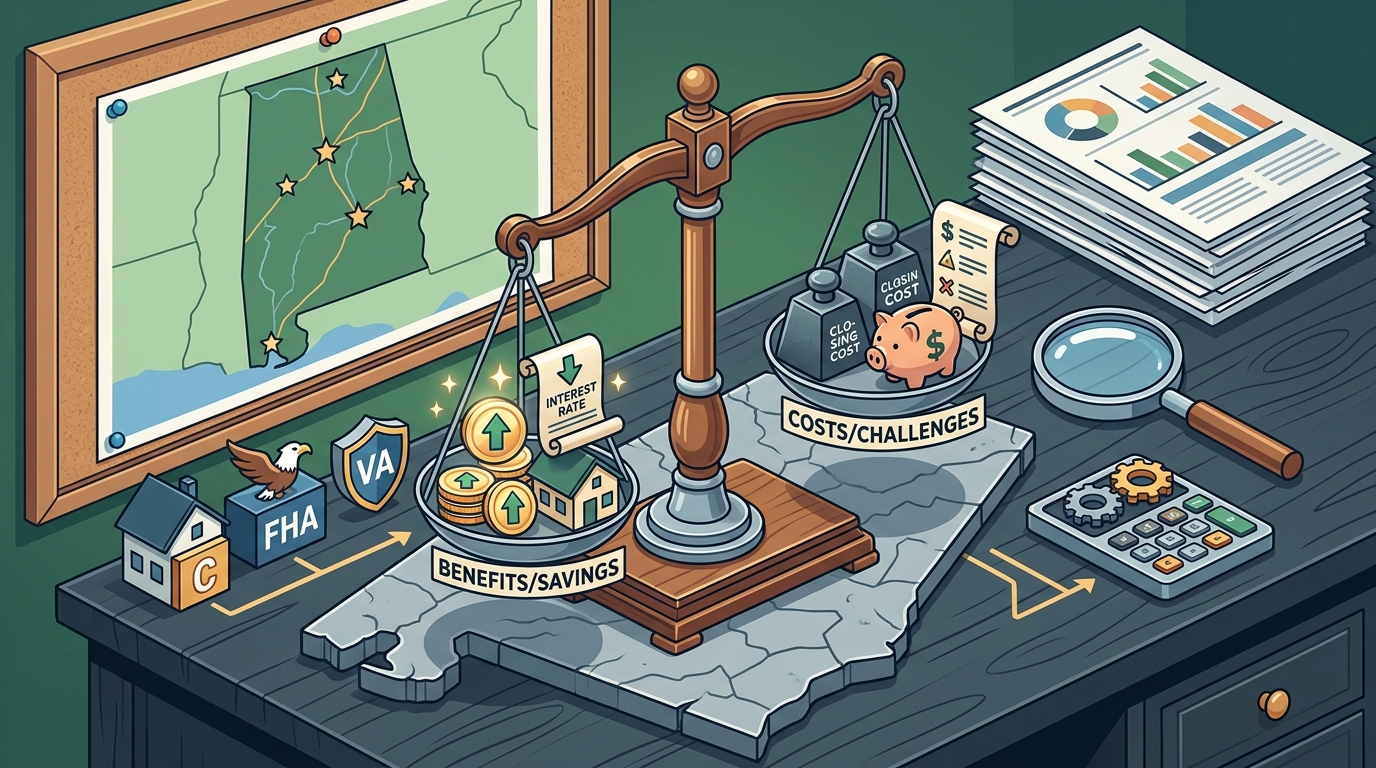
Refinancing a mortgage with a high Loan-to-Value (LTV) ratio in Alabama presents a complex financial landscape where potential savings must be weighed against strict underwriting thresholds and closing costs. According to recent housing market data, homeowners in the Southeast are increasingly seeking to unlock equity or lower rates despite having less than 20% equity in their properties. This guide provides a rigorous cost-benefit analysis for Alabama residents considering high-LTV refinancing, focusing on conventional, FHA, and VA loan pathways available through licensed professionals.
Understanding High-LTV Refinancing
High-LTV refinancing refers to replacing an existing mortgage with a new loan where the new principal balance exceeds 80% of the home's current appraised value. Traditionally, lenders required a 20% down payment to avoid Private Mortgage Insurance (PMI). However, modern lending products have evolved to allow refinancing with significantly lower equity, provided the borrower meets specific credit and income criteria.
The core challenge in high-LTV refinancing is risk mitigation. Lenders view borrowers with less equity as higher risk because they have less financial skin in the game. Consequently, these loans often come with higher interest rates or mandatory insurance premiums compared to standard 80% LTV loans. Understanding the mechanics of Debt Service Coverage Ratio (DSCR) for investment properties or standard Debt-to-Income (DTI) ratios for primary residences is critical for qualification.
For homeowners in Alabama, navigating these requirements can be daunting without expert guidance. A Senior Loan Officer can help determine if your financial profile supports a high-LTV refinance by analyzing your credit history, employment stability, and asset reserves. Start your financial triage assessment to see if you qualify for these specialized programs.
Alabama Market Context
Alabama's real estate market has experienced significant shifts in recent years, impacting how homeowners approach refinancing. Home values in key areas like Birmingham, Huntsville, and Mobile have appreciated, potentially creating equity pockets even for those who bought at peak prices. However, interest rate volatility remains a primary concern for borrowers looking to refinance.
Data from the Federal Reserve indicates that mortgage rates have fluctuated widely, influencing the break-even point for refinancing. In Alabama, where property taxes and insurance costs vary by county, the total monthly payment impact of a refinance must be calculated carefully. A lower interest rate might reduce the principal and interest portion but could increase escrow requirements if property values have risen significantly.
Christine Cox, a Senior Loan Officer licensed in Florida, Texas, and Alabama, specializes in helping borrowers navigate these regional nuances. With over 15 years of experience, she understands the specific underwriting guidelines that apply to Alabama properties. Learn more about her approach to honest mortgage guidance and how she helps clients make informed decisions.
Loan Program Options for High-LTV Refinancing
Not all high-LTV refinancing products are created equal. The best option depends on your property type, occupancy status, and financial history. Below is a comparison of the primary pathways available to Alabama homeowners.
| Loan Type | Max LTV | Best For | Key Requirement |
|---|---|---|---|
| Conventional 97 | 97% | Primary residences with strong credit | PMI required; 3% down equivalent |
| FHA Streamline | Up to 100%* | Existing FHA borrowers seeking rate reduction | Seasoning period; no appraisal often needed |
| VA Interest Rate Reduction Refi Loan (IRRRL) | 100% | Veterans and active military | Net tangible benefit; no appraisal |
| Cash-Out Refinance | 80-90% | Homeowners with equity seeking capital | Strong credit; debt-to-income analysis |
*FHA cash-out refinances typically cap at 85% LTV, while streamline refinances may allow higher effective LTVs depending on the scenario.
Conventional Loans
Conventional loans are often the go-to for borrowers with good credit scores (typically 620 or higher) who want to avoid government-backed insurance. The Conventional Loan program allows for LTVs up to 97% for primary residences. However, high-LTV conventional loans require Private Mortgage Insurance (PMI), which adds to the monthly cost. The benefit is that PMI can be removed once the LTV drops to 78% through amortization or appreciation.
VA Loans
For veterans and active military personnel, VA loans offer the most flexible high-LTV refinancing options. The VA Interest Rate Reduction Refi Loan (IRRRL) allows borrowers to refinance their existing VA loan with no down payment and often no appraisal. This is ideal for Alabama veterans looking to lower their monthly payments without touching their equity. Explore VA loan options to see if you qualify for these benefits.
FHA Loans
FHA loans are suitable for borrowers with lower credit scores or higher debt-to-income ratios. The FHA Streamline Refinance is designed for existing FHA borrowers to reduce their interest rate with minimal documentation. However, it does not allow for cash-out. For those needing cash, the FHA Cash-Out Refinance is available but has stricter LTV caps and insurance requirements.
Cost-Benefit Analysis Framework
Conducting a cost-benefit analysis for high-LTV refinancing requires looking beyond the interest rate. You must calculate the break-even point, which is the time it takes for monthly savings to equal the closing costs of the new loan.
Calculating the Break-Even Point
The formula is straightforward: Total Closing Costs divided by Monthly Savings equals the number of months to break even. For example, if your closing costs are $4,000 and your new loan saves you $200 per month, your break-even point is 20 months. If you plan to sell your home in Alabama within 18 months, refinancing may not be financially prudent.
Use the Refinance Savings Calculator to estimate your potential monthly savings and break-even timeline. This tool helps you visualize the financial impact of different rate scenarios.
Understanding Closing Costs
Closing costs for high-LTV refinances can be higher due to increased insurance premiums and lender fees. In Alabama, typical closing costs range from 2% to 5% of the loan amount. Some borrowers choose to roll these costs into the new loan balance, which increases the LTV and the total interest paid over the life of the loan. This strategy should be used cautiously, as it reduces the immediate benefit of the refinance.
The Impact of PMI
If you are refinancing into a conventional loan with an LTV above 80%, you will likely pay PMI. This insurance can cost 0.5% to 1.5% of the loan amount annually. When analyzing the cost-benefit, ensure that the interest rate reduction outweighs the added PMI cost. In some cases, a slightly higher interest rate with no PMI may be more cost-effective than a lower rate with PMI.
Strategic Considerations for Alabama Homeowners
Beyond the math, there are strategic factors to consider when refinancing in Alabama. Market conditions, personal financial goals, and long-term housing plans all play a role in the decision.
Property Appreciation and Equity
If your home has appreciated significantly, your LTV may have dropped naturally, potentially allowing you to refinance at better terms. Conversely, if you are in a market with stagnant or declining values, maintaining a high LTV can be risky. A DSCR Loan might be more appropriate if you are an investor looking to leverage property cash flow rather than personal income.
Credit Profile and Underwriting
High-LTV refinancing is sensitive to credit scores. A drop in your credit score since your original mortgage could result in higher rates or denial. Lenders look for stability in employment and income. Self-employed borrowers in Alabama may find it challenging to qualify for traditional high-LTV refinances due to the complexity of verifying income. In such cases, Self-Employed Loans using bank statement qualifying may be a viable alternative.
Long-Term Housing Plans
How long do you plan to stay in your home? If you are planning to move within a few years, the costs of refinancing may not be recouped. However, if you intend to stay long-term, even a small rate reduction can result in significant savings over the life of the loan. Christine Cox can help you model these scenarios to ensure your decision aligns with your long-term goals. Contact Christine Cox for a personalized strategy call.
Key Takeaways
- Break-Even Analysis is Critical: Always calculate the break-even point before refinancing. If you plan to sell before this point, the refinance may not be worth the cost.
- PMI Costs Matter: High-LTV conventional loans require PMI, which can negate the benefits of a lower interest rate. Compare total monthly payments, not just the interest rate.
- VA Loans Offer Flexibility: Veterans in Alabama can utilize the IRRRL program for easy refinancing with no down payment and often no appraisal.
- Credit Score Sensitivity: High-LTV refinancing is more sensitive to credit scores. Ensure your credit profile is strong before applying.
- Self-Employed Options Exist: If you are self-employed, traditional W-2 underwriting may not reflect your true cash flow. Consider bank statement qualifying options.
- Local Expertise Helps: Alabama's market varies by region. Working with a local Senior Loan Officer ensures you get accurate valuations and underwriting insights.
- Equity Lines are an Alternative: If refinancing is not feasible, a HELOC can provide access to equity without disrupting your existing low-rate mortgage.
Frequently Asked Questions
Can I refinance my mortgage in Alabama with less than 20% equity?
Yes, high-LTV refinancing options are available. Conventional loans can go up to 97% LTV for primary residences, while VA and FHA loans offer even more flexibility for eligible borrowers. However, these loans typically require Private Mortgage Insurance (PMI) or FHA mortgage insurance premiums.
What is the break-even point for refinancing?
The break-even point is the time it takes for your monthly savings to equal the closing costs of the new loan. It is calculated by dividing total closing costs by the monthly savings. If you plan to sell your home before this point, refinancing may not be financially beneficial.
Do I need a new appraisal for a high-LTV refinance?
It depends on the loan program. VA IRRRLs and FHA Streamline refinances often do not require a new appraisal. Conventional high-LTV refinances usually do require an appraisal to confirm the current value of the property and ensure the LTV is accurate.
How does PMI work in high-LTV refinancing?
Private Mortgage Insurance (PMI) protects the lender if you default on the loan. For conventional loans with an LTV above 80%, PMI is typically required. It can be paid monthly, upfront, or as a combination of both. PMI can be removed once the LTV drops to 78% through amortization or appreciation.
Can self-employed borrowers qualify for high-LTV refinancing?
Yes, but the underwriting process may differ. Traditional W-2 underwriting may not reflect your true cash flow. Self-employed borrowers can often qualify using bank statement qualifying or CPA-prepared Profit & Loss statements, which provide a more accurate picture of income.
What is the difference between a rate-and-term refinance and a cash-out refinance?
A rate-and-term refinance changes your interest rate and/or loan term without changing the principal balance (or changing it slightly). A cash-out refinance increases the principal balance, allowing you to take cash out of your home's equity. Cash-out refinances typically have stricter LTV limits and higher interest rates.
How can I access equity without refinancing my primary mortgage?
You can use a Home Equity Line of Credit (HELOC) or a second mortgage. This allows you to tap into your equity while keeping your primary mortgage at its current low interest rate. Apply for a HELOC online to explore this option.
Next Steps
Refinancing with a high LTV in Alabama is a strategic financial move that requires careful analysis. By understanding the costs, benefits, and available programs, you can make a decision that aligns with your long-term goals. Christine Cox, a Senior Loan Officer with NEXA Mortgage, is licensed in Florida, Texas, and Alabama, and specializes in helping borrowers navigate these complex scenarios.
Don't navigate the mortgage process alone. Get clear, honest guidance tailored to your unique financial situation. Start your financial triage assessment today to see if high-LTV refinancing is the right move for you. Or, schedule a strategy call to discuss your options with a trusted advisor.